
Article · Jul 16, 2026
Retail Showrooms Need Visual Proof Systems
How NY/NJ retail and showroom brands can turn product photos, profile visuals, packaging, print collateral, website sections, and production-ready files into AI/local discovery proof.
14 min read
Retail and showroom brands are being judged across Google, social profiles, AI summaries, website previews, packaging photos, and printed sales materials. A visual proof system makes the business easier to trust, easier to understand, and easier to refresh without losing consistency.
In this article
- 01Retail discovery is no longer one storefront moment
- 02AI search makes vague retail branding weaker
- 03Visual proof is different from visual polish
- 04Build the system around customer decisions
- 05Tactile materials create human brand texture
- 06Packaging and print should be photographed on purpose
- 07Profile visuals should lead into the website
- 08Production-ready files keep seasonal updates consistent
- 09A practical refresh path for NY/NJ retail brands
Retail discovery is no longer one storefront moment
A NY/NJ shopper may decide whether a boutique, showroom, home goods store, beauty retailer, furniture studio, or specialty product brand feels worth visiting before they see the full website. They may scan Google photos, compare Instagram covers, open a map result, read an AI-generated summary, look at product thumbnails, save a reel, or receive a link to a collection page from a friend. The first impression is scattered across many small surfaces.
That makes visual consistency more practical than decorative. The question is not only whether the store looks attractive. The question is whether the images, packaging, product cards, profile visuals, website sections, and printed materials all prove the same thing: what the brand sells, who it is for, what level of quality to expect, and why the customer should take the next step.
AI search makes vague retail branding weaker
Recent search guidance keeps pointing toward useful, non-commodity content, clear technical structure, and accurate local business details. For retail brands, that means a website and profile system should do more than publish polished lifestyle language. AI search and map-based discovery need clear categories, product context, location cues, FAQs, service details, and enough supporting evidence to understand what makes the business specific.
This is where many small retail brands lose trust. Their Instagram may show beautiful product close-ups, their Google profile may show older store photos, their website may use generic collection text, and their printed tags may feel like a separate brand. Humans notice the mismatch as a subtle lack of preparedness. Answer engines may also struggle to connect the business to clear local intent.
- Keep product categories, service areas, store details, and collection names consistent.
- Use website headings and FAQs that answer how customers shop, visit, order, or book.
- Support those answers with real product, showroom, packaging, and print visuals.
- Update local profile images before they become disconnected from the current brand.
Visual proof is different from visual polish
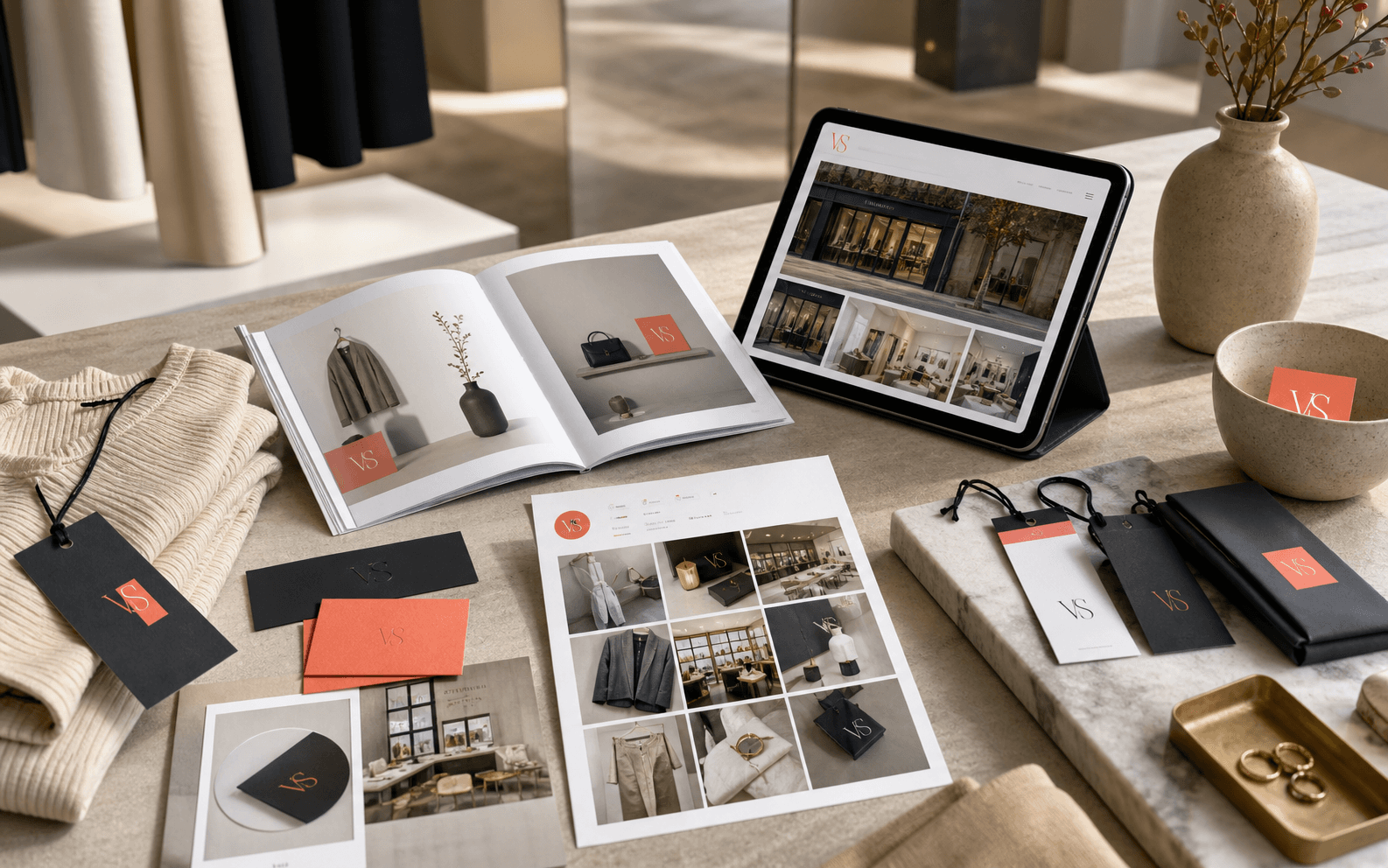
Polish makes a brand look clean. Proof makes a customer believe the business is real, current, and worth choosing. For a retail showroom, proof can come from a product tag that looks considered, a lookbook page that explains a collection, a packaging label that photographs well, a display card that clarifies materials, or a website grid that makes inventory easy to browse.
These details should not feel like random props. They should be designed as a system that can appear on the website, Google Business Profile, Instagram, printed collateral, email graphics, and in-store displays. When the same visual language moves across channels, the customer does not have to work to understand the brand. The business feels prepared before a salesperson says a word.
Build the system around customer decisions
Retail and showroom customers make several decisions before they buy. Is this the right style? Is it in my price range? Can I visit easily? Do I need an appointment? Is the product available now or made to order? Does the store ship? Can I trust the material, size, fit, finish, or service process? A strong visual proof system answers those questions in the places customers already look.
The website should carry structured collection pages, clear store or showroom information, service explanations, product care notes, appointment or inquiry paths, and FAQs. The visual system should support those pages with product families, detail images, packaging shots, printed cards, showroom views, and social crops. This is conversion-led web design, but it also makes the business easier for AI search and local discovery systems to describe.
Tactile materials create human brand texture
AI-generated design and template-based content have made many retail brands look smoother and more similar at the same time. Human texture helps break that sameness, especially for local businesses where customers want signs of real taste, care, and curation. In retail, texture often lives in the physical layer: paper stock, tag strings, label edges, foil, embossing, fabric, wood, ceramic, packaging seals, and handwritten service notes.
The point is not to make every brand rustic or handmade. A premium showroom can be minimal and tactile at once. A beauty retailer can feel clinical and warm. A fashion boutique can feel editorial without becoming impractical. The design system should decide which tactile details belong to the brand, then capture and export them so they can support web, print, social, and local profile channels.
Packaging and print should be photographed on purpose
Small-batch packaging and print collateral are not only production outputs. They are reusable marketing assets. Product tags, warranty cards, gift cards, loyalty cards, care cards, lookbooks, shopping bags, stickers, inserts, material cards, and appointment sheets often appear in photos more than the logo itself. If they are designed well, they can make a small retail brand feel more established.
Plan those materials with photography and web use in mind. A tag needs enough contrast to read in a close crop. A care card should work in a printed bag and as a website detail image. A lookbook spread should create a strong social cover without forcing tiny type into a phone layout. A packaging label should have print-ready specifications, but it should also look credible when it appears in a Google profile photo.
Profile visuals should lead into the website
A customer who clicks from Google or Instagram should not feel like they entered a different brand. If the profile image shows a warm showroom with tactile product details, the website should continue that promise with matching photography, product categories, service pages, and inquiry paths. If social highlights custom consultations, the website needs a clear consultation or appointment section.
This connection matters for AI search readiness too. A business sends stronger signals when profile descriptions, website page titles, FAQs, product category copy, social documents, and printed materials all describe the same offer. It does not need to repeat the same words everywhere. It needs to maintain the same facts: what is sold, where the business serves, how customers buy, what makes the offer credible, and what action comes next.
Production-ready files keep seasonal updates consistent
Retail brands change often. New collections arrive, products sell through, holiday packaging appears, sale signage needs to be posted, lookbooks are revised, and social campaigns shift quickly. Without organized files, every update becomes a scramble. A store pulls an old logo from a PDF, crops a product photo too tightly, sends a printer the wrong label file, or posts a social graphic that no longer matches the website.
A usable file system should include editable source files, approved logo exports, print-ready PDFs, product image crops, profile-safe images, website thumbnails, social cover templates, packaging specifications, lookbook layouts, and a naming rule that the team can follow. This is not back-office tidiness. It is what lets a local retail brand move quickly while still looking like one coherent business.
- Create square, vertical, horizontal, and thumbnail crops for priority visuals.
- Separate editable source files, approved exports, and vendor-ready print files.
- Keep product, packaging, website, social, and Google profile assets in related folders.
- Save short approved copy blocks for product categories, services, FAQs, and local context.
A practical refresh path for NY/NJ retail brands
Start with the surfaces customers see before they visit or inquire: Google Business Profile, Instagram grid, shared link previews, website homepage, product or collection pages, appointment information, printed tags, packaging, and in-store cards. Mark which assets are current, which feel generic, which are hard to read on mobile, and which do not explain the buying decision.
Then build one visual proof kit around a high-value category or upcoming campaign. A realistic first phase could include a stronger product image set, updated profile crops, one collection page, one printed card or lookbook spread, packaging photo direction, social cover templates, FAQ copy, and a clean export folder. That connects brand identity, web design, print collateral, packaging, marketing assets, AI search readiness, and production-ready files without turning the project into a signage-only refresh.
Frequently asked questions
What is a visual proof system for a retail brand?
It is a coordinated set of product photos, profile visuals, website sections, printed materials, packaging details, social crops, and production-ready files that make the brand easier to understand and trust.
How does this help AI search readiness?
It supports clear, consistent signals across the website, local profiles, FAQs, product categories, printed assets, and social content so people and answer engines can understand what the business offers.
Which retail visuals should be refreshed first?
Start with Google profile images, social cover visuals, product category photos, website thumbnails, packaging or tag details, and any printed pieces that customers handle or see in photos.
Do retail brands need print collateral if they sell mostly online?
Often yes. Tags, inserts, care cards, packaging labels, lookbooks, and gift cards can strengthen the brand physically and create useful content for web, social, profile images, and campaigns.
Need a sharper customer-facing system?
Improve consistency across the brand, website, and sales materials.
Visual Square helps NY/NJ businesses clean up the touchpoints customers actually see first, so the brand feels clearer, more credible, and easier to trust.
Talk through the refresh