
Article · Jul 31, 2026
Real Estate Marketing Needs Answer-Ready Property Systems
How NY/NJ real estate teams can connect property pages, brochures, profile visuals, print collateral, and production-ready files for AI search and buyer confidence.
14 min read
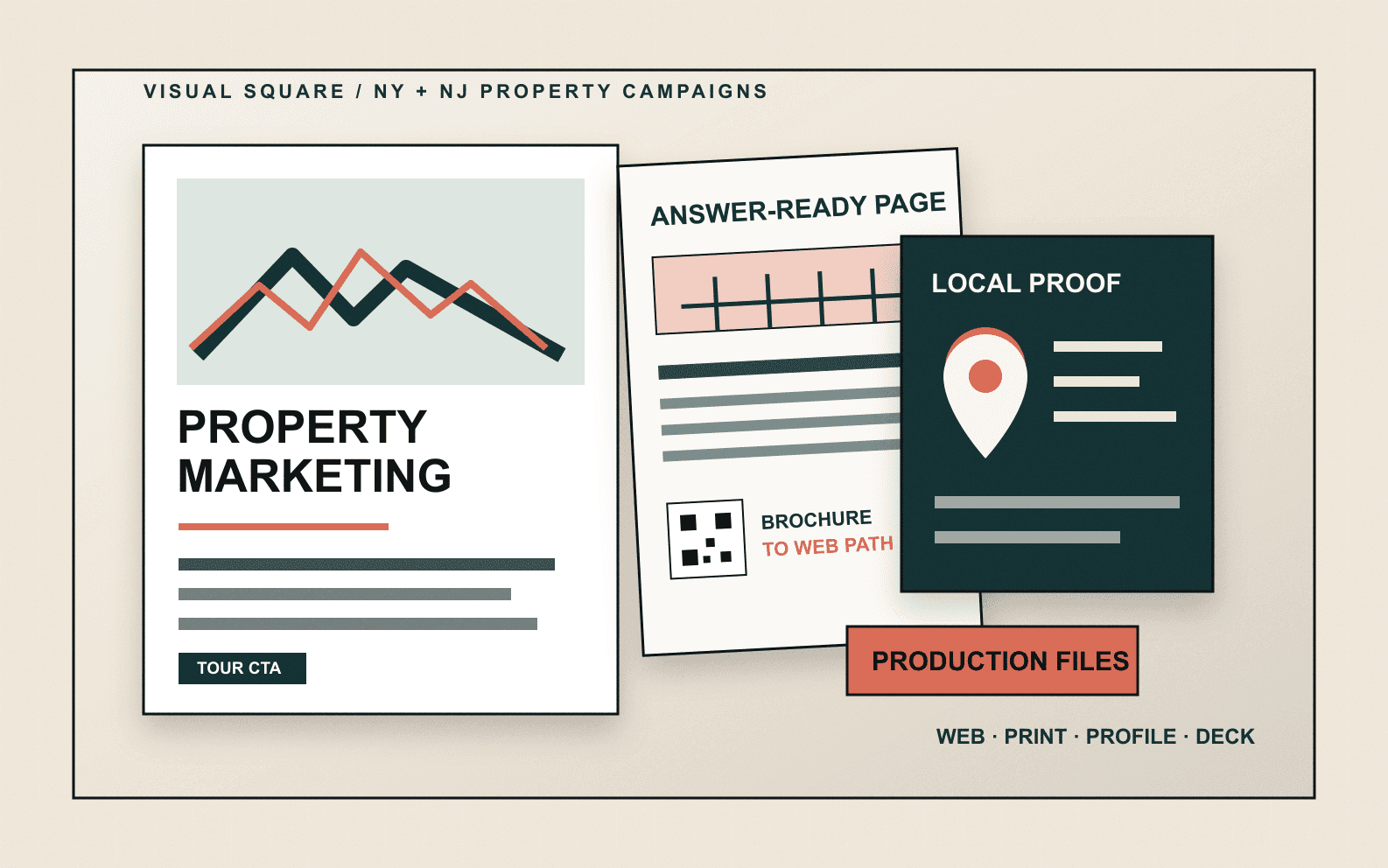
Property marketing works harder when the website, brochure, sales deck, profile visuals, local proof, and production files answer buyer and tenant questions as one coordinated system.
In this article
- 01Property discovery now happens across many surfaces
- 02AI search rewards specific property information
- 03Human proof makes the property feel real
- 04The brochure and website should share one structure
- 05Print collateral still builds confidence
- 06Profile visuals are part of the campaign
- 07Production-ready files protect speed and accuracy
- 08A practical refresh path for NY/NJ property teams
Property discovery now happens across many surfaces
A buyer, tenant, investor, or referral partner may not start with a polished listing brochure. They may see a Google result, ask an AI search tool for shortlists, open a property page, compare map results, skim a broker profile, review a PDF, look at a LinkedIn carousel, scan an email preview, or pick up a printed sheet at a meeting. The property brand is judged through all of those moments together.
That is why real estate marketing in New York and New Jersey needs more than attractive photography and a logo lockup. Dense local markets create fast comparison behavior. A boutique residential project in Jersey City, a mixed-use opportunity in Queens, a retail lease in Bergen County, an office sublease in Manhattan, or a development site near a transit corridor must answer practical questions quickly while still feeling premium. The strongest campaigns connect brand identity, web design, print collateral, marketing assets, and production-ready files into one answer-ready system.
AI search rewards specific property information
Recent guidance from Google on generative AI search is useful because it pulls the conversation back to fundamentals. Optimizing for AI search is still optimizing for the search experience: clear technical structure, useful original content, accurate business information, and people-first answers matter more than special markup files or invented GEO shortcuts. For property marketing, this means a thin page with photos and a vague paragraph is not enough.
A property page should explain the opportunity in a way a person can understand and a search system can interpret. That includes property type, location context, availability, size, permitted or likely uses, transit and parking details, neighborhood demand drivers, nearby anchors, timing, inquiry path, and the most common questions a qualified lead will ask. The copy should not sound like a generic listing database. It should translate the asset into decisions.
- Create a dedicated page or section for each priority property, development, lease campaign, or sales opportunity.
- Use clear headings for location, availability, property details, use cases, neighborhood context, documents, and next steps.
- Add FAQs around timing, tours, zoning or use assumptions, parking, transit, delivery, building access, and documentation.
- Keep contact actions specific: request the brochure, schedule a tour, ask for financials, review the deck, or speak with the listing team.
Human proof makes the property feel real
The design trend away from AI-polished sameness matters in real estate because property marketing can easily become anonymous. Renderings, clean serif headlines, smooth gradients, aerial photos, and templated feature lists can look expensive while still feeling interchangeable. Prospects want evidence that the opportunity is real, current, local, and thoughtfully prepared.
Human proof can come from details that are specific to the property and neighborhood: street-level photography, facade texture, lobby materials, window light, nearby transit cues, retail frontage, sidewalk context, floor plan annotations, broker notes, printed brochure spreads, map callouts, and signage mockups where appropriate. These details should be art-directed, not random. The goal is to make the opportunity tangible without drifting into a signage-only project. The brand should support the full campaign: website, PDF, printed materials, social visuals, email, and presentation files.
The brochure and website should share one structure
Real estate teams often build the website page, brochure, email graphic, and presentation deck as separate deliverables. That creates extra work and mixed signals. A prospect may see one square footage number in an email, a different phrasing in a PDF, and a third version on the web page. Even small inconsistencies can make the opportunity feel less controlled.
A stronger system starts with one information architecture. The same core story should appear across the website and printed brochure: what the property is, where it sits, why the location matters, who it fits, what proof supports the claim, what details are available, and what the prospect should do next. The design can adapt by channel, but the hierarchy stays connected. This is especially useful for NY/NJ teams coordinating owners, brokers, developers, photographers, printers, and legal or operations stakeholders.
- Build a reusable content block for the property summary, location value, specs, amenities, availability, and inquiry path.
- Design the web page and PDF around the same section order so updates do not fragment.
- Use one approved set of maps, floor plans, image captions, QR paths, and short descriptions.
- Keep version notes visible so teams know which brochure, deck, and web copy are current.
Print collateral still builds confidence
Printed real estate collateral remains useful because many property decisions still involve meetings, tours, desks, folders, and shared PDFs that began as print layouts. A brochure, flyer, tour sheet, neighborhood map, investment summary, lookbook, or presentation cover can give a prospect something organized to review after the first impression. The physical piece can also signal that the listing team has prepared the opportunity carefully.
Print should not be treated as a last-minute export from the website. It has its own production rules: trim size, bleed, margins, fold, paper, binding, image resolution, color, proofing, and vendor instructions. If those rules are considered early, the same design system can create a premium printed piece and a clean digital PDF. If they are handled late, the team may end up with cramped layouts, weak images, or files that need to be rebuilt under deadline.
Profile visuals are part of the campaign
Real estate profile visuals are often overlooked. Broker pages, LinkedIn posts, Google Business Profile images, Instagram grids, listing platform thumbnails, email headers, and shared link previews may be the first image a prospect sees. If those visuals are improvised from the same photo folder each time, the campaign loses consistency before the person reaches the brochure.
A property visual system should include image crops for different surfaces. Wide hero images can carry the website. Square crops can support profile cards and Instagram. Vertical crops can support carousels and stories. Small thumbnails need simpler compositions. Detail images can show materials, streetscape, floor plan areas, brochure spreads, or neighborhood anchors. The point is not to make every surface identical. It is to make every surface recognizably part of the same property campaign.
Production-ready files protect speed and accuracy
The operational risk in property marketing is usually file drift. A designer exports a brochure, a broker edits copy in a separate deck, a photographer sends new images, a printer asks for bleed, a social post uses an old map, and the website still has a previous availability note. The more successful the campaign becomes, the more people touch the files.
A production-ready system reduces that risk. It separates editable source files, approved PDFs, compressed web images, social crops, print vendor files, map exports, floor plan assets, QR destinations, copy blocks, and archived versions. File names should identify the property, channel, size, date, and approval status. A simple system lets a busy team move quickly without turning every update into a hunt for the right asset.
- Store source files separately from approved final exports and vendor PDFs.
- Prepare web, print, email, LinkedIn, Instagram, and thumbnail crops before launch.
- Keep maps, floor plans, image captions, disclaimers, QR links, and contact details in one campaign folder.
- Use naming rules that make the property, channel, date, and approval status obvious.
A practical refresh path for NY/NJ property teams
Start with one active or upcoming campaign. It might be a new residential listing, a commercial lease, a development site, a retail space, a multi-family sale, a hospitality opportunity, or a property management offering. Audit the website page, brochure, PDF deck, email template, profile images, social posts, map assets, floor plans, and print files connected to that campaign.
Then rebuild the campaign as one system. Define the property story, organize answer-ready page sections, select human proof images, design the print/PDF hierarchy, prepare profile and social crops, confirm QR paths, and export production-ready files for vendors and internal use. The result is more than a nicer listing. It is a practical marketing system that helps people understand the opportunity, helps AI search systems read the content, and helps the team keep every touchpoint credible from first search to serious inquiry.
Frequently asked questions
What is an answer-ready real estate marketing system?
It is a connected set of property pages, brochures, decks, visuals, FAQs, profile assets, and production files that answer buyer, tenant, investor, or referral questions consistently across channels.
How does this help AI search readiness?
AI search readiness improves when property information is clear, specific, useful, locally grounded, and consistent across the website, PDFs, profiles, and supporting marketing assets.
Which assets should a property campaign prepare first?
Start with the website page, property summary, brochure or PDF deck, map, floor plan, image crops, inquiry CTA, social cover, email graphic, and print-ready file exports.
Does every listing need a custom brand system?
Not every listing needs a full identity, but serious campaigns benefit from a focused system that controls the message, visuals, print collateral, digital assets, and production files.
Need stronger production support?
Turn the design system into vendor-ready files that actually ship well.
We help organize brochures, decks, flyers, menus, and other customer-facing materials so they stay consistent from layout through production handoff.
Review the asset system