
Article · Aug 7, 2026
Human Proof for AI-Ready Service Websites
How NY/NJ professional service firms can avoid generic AI polish by connecting real proof, web structure, print/PDF collateral, profile visuals, and production-ready files.
11 min read
AI tools can make a professional service website look cleaner, but they cannot make it more believable by themselves. NY/NJ firms need human proof assets: specific process evidence, document systems, profile visuals, printed leave-behinds, and structured service content that help buyers and AI search systems understand why the firm is worth trusting.
In this article
- 01AI polish has raised the baseline and lowered distinction
- 02Human proof is evidence buyers can picture
- 03Start with the questions prospects ask before inquiry
- 04Make the website the source for reusable proof assets
- 05Profile visuals should show the working method
- 06AI search readiness needs structure, not keyword stuffing
- 07A practical refresh sequence for NY/NJ firms
AI polish has raised the baseline and lowered distinction
Professional service firms can now produce clean landing pages, polished copy, proposal covers, and social graphics faster than ever. That is useful, especially for small teams that need to move quickly. But the same tools also create a new problem: many firms start to look organized in exactly the same way. The layouts are tidy, the claims are broad, the icons are generic, and the photography could belong to almost any consultant, advisor, studio, broker, or local B2B service provider.
That matters in New York and New Jersey because prospects rarely evaluate one firm in isolation. They compare referrals, Google results, LinkedIn profiles, PDFs, review snippets, and AI-generated summaries in a short window. If every touchpoint sounds competent but interchangeable, the buyer has no strong reason to remember the firm. The question is no longer whether the site looks modern. The question is whether it carries enough specific evidence to feel real.
Human proof is evidence buyers can picture
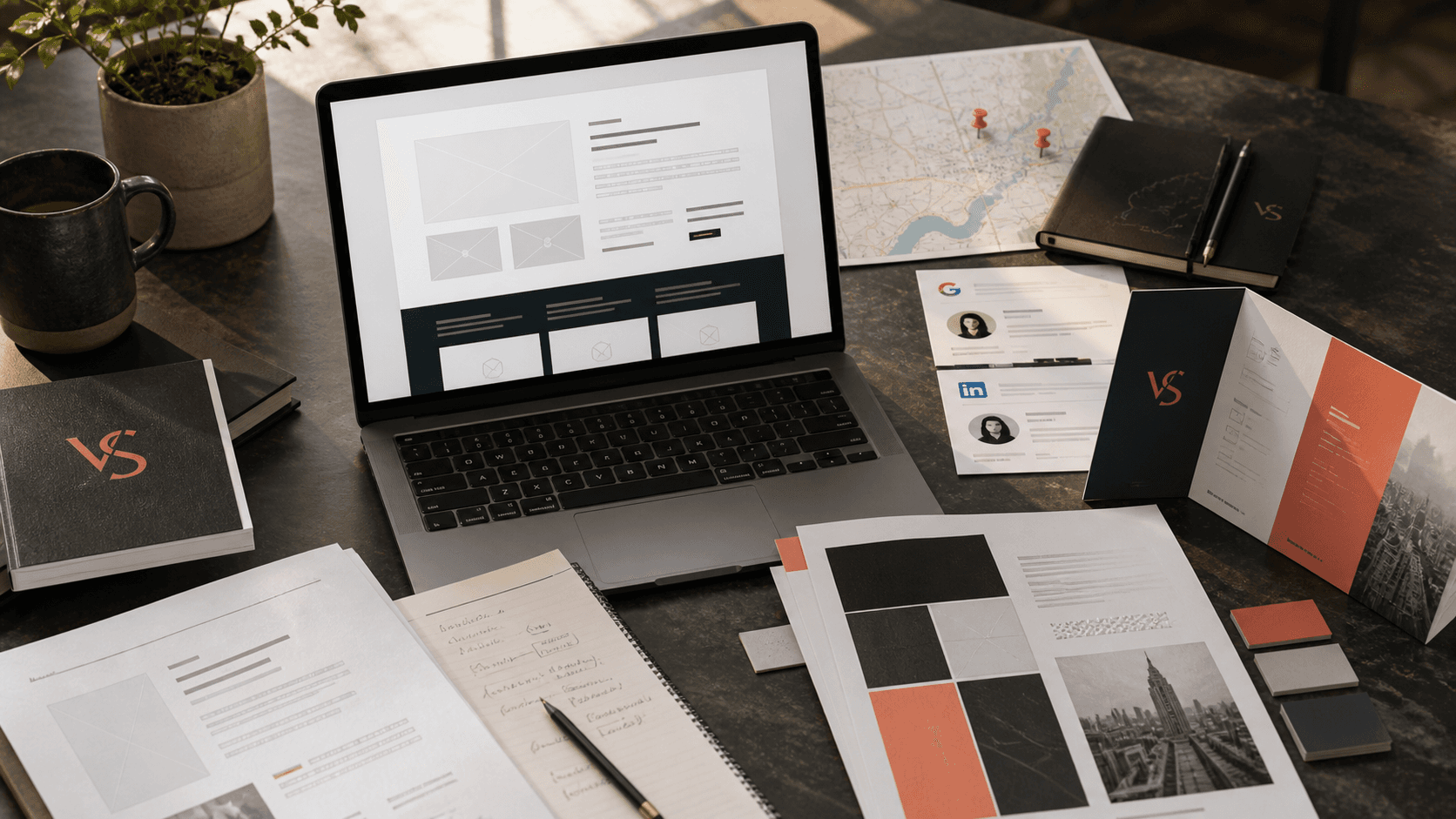
Human proof is not a decorative handmade style. It is the set of concrete signals that make a professional service firm easier to believe. A planning worksheet, annotated process diagram, before-and-after document structure, photographed workshop material, proposal section, service comparison table, credential one-pager, local market note, or clear FAQ can all become proof. These assets show that the firm has a way of working, not only a visual skin.
This is where brand identity and web design need to cooperate. The identity system should make proof easier to read. The website should place proof near moments of doubt. Print collateral and PDFs should carry the same explanation into sales conversations. Profile visuals should show the working system rather than another abstract office scene. When these pieces align, the brand feels more specific without becoming loud.
Start with the questions prospects ask before inquiry
A useful service website begins with the buyer's uncertainty. What does the firm actually do? Is this service for a small business, a growing practice, a property team, a founder, or an established local operator? What happens after the first call? What should the client prepare? What proof can be shown without violating confidentiality? How local is the firm? Does it understand NY/NJ timelines, competition, bilingual audiences, or the practical pressure of a launch or refresh?
Those questions should shape the page structure before style decisions take over. A stronger service page has a clear opening answer, plain-language service explanation, who-it-is-for section, process overview, proof module, FAQ, local context, and specific next step. That structure helps human buyers scan quickly and gives AI search systems cleaner information to understand, quote, and summarize.
- Replace broad claims with specific service, buyer, and outcome language.
- Put proof next to the section where a prospect is likely to hesitate.
- Use FAQ language that matches real sales calls and intake questions.
- Connect local context to practical decisions, not decorative NY/NJ name-dropping.
Make the website the source for reusable proof assets
The website should not be a separate marketing layer from the materials used in conversations. For many professional service firms, the same proof has to travel from a web page into a one-page PDF, proposal deck, LinkedIn document, email follow-up, printed leave-behind, and Google Business Profile update. If every version is rewritten and redesigned from scratch, the message drifts and the brand starts to feel improvised.
A better system treats the website as the source of approved proof modules. A service summary can become the top of a PDF. A process diagram can become a deck slide and a printed handout. A proof block can become a social carousel card. A FAQ answer can become an email response. This is not mechanical duplication. It is disciplined reuse, which is exactly what a busy local firm needs when campaigns, referrals, hiring, and seasonal updates all compete for attention.
Profile visuals should show the working method
Professional service firms often underinvest in visuals because they do not sell a physical product. But buyers still see images before they read deeply: Google profile photos, LinkedIn banners, document covers, webinar thumbnails, proposal previews, website cards, and shared link images. If those visuals are generic, the firm feels less specific than its expertise actually is.
Human proof visuals can be restrained and premium. Show branded document sets, planning boards, annotated worksheets, process maps, carefully cropped meeting materials, refined team portraits, local office context, printed one-pagers, or a laptop beside real campaign files. The goal is not to expose private client work. The goal is to show enough of the firm's method that the brand feels inhabited by real expertise.
AI search readiness needs structure, not keyword stuffing
Recent search and web design discussions keep pointing to the same operational shift: AI-assisted discovery depends on clear, structured, trustworthy information. That does not mean professional service pages should become robotic. It means headings should answer real questions, summaries should define the service clearly, schema and FAQ blocks should support the content, and internal links should connect services, industries, proof, and contact paths.
Design affects that structure. If the page hides the answer behind a vague hero, uses image-only text, buries local context, or separates proof from the service explanation, both buyers and search systems have to work harder. A clean page with weak evidence is still weak. A useful page with strong hierarchy, readable typography, specific proof, and production-ready supporting assets can serve traditional SEO, GEO, sales enablement, and brand trust at the same time.
- Use direct headings for services, process, proof, location, FAQ, and next steps.
- Keep business information consistent across website, Google profile, PDFs, and social profiles.
- Support important claims with examples, process artifacts, credentials, or practical details.
- Prepare short social cover titles so long SEO headlines do not break carousel layouts.
A practical refresh sequence for NY/NJ firms
Start with a proof audit. Review the homepage, top service pages, Google Business Profile, LinkedIn page, proposal deck, one-pager, printed collateral, email signature, social covers, and any downloadable PDFs. Mark what feels generic, what proves real expertise, what is outdated, what conflicts with the current offer, and what could be reused across channels if it were cleaned up.
Then build one human proof kit around the highest-value service. A realistic first kit might include a rewritten service page, one proof module, a process diagram, FAQ set, Google profile image crops, LinkedIn document cover, one print-ready PDF, a proposal section, and organized source/export folders. This gives the firm something more useful than another layer of polish: a brand, web, print, social, and AI-search-ready system that buyers can actually understand.
Frequently asked questions
What is human proof in professional service branding?
Human proof is the specific evidence that makes expertise believable: process artifacts, service explanations, proof modules, document systems, FAQs, profile visuals, print collateral, and local context.
Does an AI-ready website have to sound robotic?
No. The best AI-ready pages are written for people first, but they use clear structure, specific service language, FAQ answers, schema, and proof so search systems can understand them accurately.
Which assets should a firm refresh first?
Start with the homepage, highest-value service page, Google and LinkedIn visuals, proposal deck, one-page PDF, and any printed leave-behind used before or after a sales conversation.
How do production-ready files support brand trust?
They keep web images, social covers, PDFs, print files, and proposal assets consistent, findable, and ready to use when the firm needs to move quickly.
Need a sharper customer-facing system?
Improve consistency across the brand, website, and sales materials.
Visual Square helps NY/NJ businesses clean up the touchpoints customers actually see first, so the brand feels clearer, more credible, and easier to trust.
Talk through the refresh