
Article · Jul 10, 2026
AI Search-Ready Med Spa Service Pages Need Human Proof
How NY/NJ med spas can structure service pages for AI search while using brand identity, treatment visuals, print collateral, and production-ready files to build real patient trust.
13 min read
AI search is making clear website structure more important, but med spa customers still decide with human signals: specific treatment explanations, credible visuals, consistent brand language, aftercare materials, and files that make every touchpoint feel prepared.
In this article
- 01AI search rewards clarity, but patients reward specificity
- 02The problem with AI-polished treatment copy
- 03Build pages around decisions, not keywords alone
- 04Brand identity should guide the medical-beauty balance
- 05Use visuals as evidence, not decoration
- 06Print collateral can make the website more believable
- 07Prepare content blocks for AI search and staff use
- 08Production-ready files prevent refresh drift
- 09A practical refresh path
AI search rewards clarity, but patients reward specificity
Med spa website content is entering a different search environment. Customers are still using Google, maps, social profiles, and referral links, but more of the research journey is being summarized by AI tools and answer-style search results. A vague service page that says a treatment is innovative, customized, and confidence-boosting is easy for a human to skim past and difficult for an answer engine to trust.
That does not mean every med spa should turn its website into a technical manual. The goal is clearer structure with more specific proof. A strong service page explains what the treatment is, who it may be for, what the visit feels like, what questions a first-time client usually asks, and what the next step should be. For NY/NJ med spas competing across dense local markets, that specificity can be more persuasive than another glossy promise.
The problem with AI-polished treatment copy
AI tools have made it easier to produce long service descriptions quickly. The downside is sameness. Many treatment pages now sound like they came from the same template: elevated care, natural-looking results, advanced technology, personalized plan, book your consultation. None of those phrases are wrong, but they rarely help a customer decide between two local providers.
Human proof is the antidote. It can show up as real treatment-room photography, clear process language, service menu hierarchy, practitioner point of view, aftercare cards, appointment prep details, and visual cues that match the actual experience. The brand should feel polished, but it should not feel synthetic. Customers need enough concrete detail to believe the business is real, careful, and prepared.
- Replace generic claims with treatment-specific explanations.
- Use real visual details from the studio, consultation flow, and printed materials.
- Write FAQs around questions clients actually ask before booking.
- Keep the brand voice calm, premium, and direct instead of overpromising.
Build pages around decisions, not keywords alone
A service page has to serve several audiences at once. A potential client wants to know whether the treatment fits their concern, budget, timing, comfort level, and trust threshold. A search engine wants organized information. An AI answer engine wants clear entities, direct answers, local relevance, and credible context. A staff member wants a page they can confidently send to a lead.
The practical structure is simple: start with a plain-language explanation, add who it is for, describe the consultation or treatment flow, clarify preparation and aftercare, answer common questions, show supporting visuals, and make the next action obvious. This is conversion-led web design, but it is also GEO-ready content structure. It helps the page become easier to understand, quote, compare, and act on.
Brand identity should guide the medical-beauty balance
Med spa brands often struggle with balance. Too clinical can feel cold. Too beauty-driven can feel unserious. Too luxury-heavy can hide important service details. The identity system should decide how the business balances expertise, warmth, privacy, and aspiration before the website copy or social graphics are produced.
That system includes more than a logo. It includes typography that can carry educational content, colors that feel refined without washing out treatment imagery, image rules that avoid stock-like perfection, and language patterns for benefits, safety, consultation, and aftercare. When the identity system is clear, service pages can feel consistent even when each treatment needs its own explanation.
Use visuals as evidence, not decoration
Many med spa websites use beautiful visuals that do not answer anything. A soft abstract background may set a mood, but it cannot explain a consultation, show treatment-room care, make aftercare feel organized, or prove that the business has a real process. In an AI-search and high-choice local market, visuals should carry evidence.
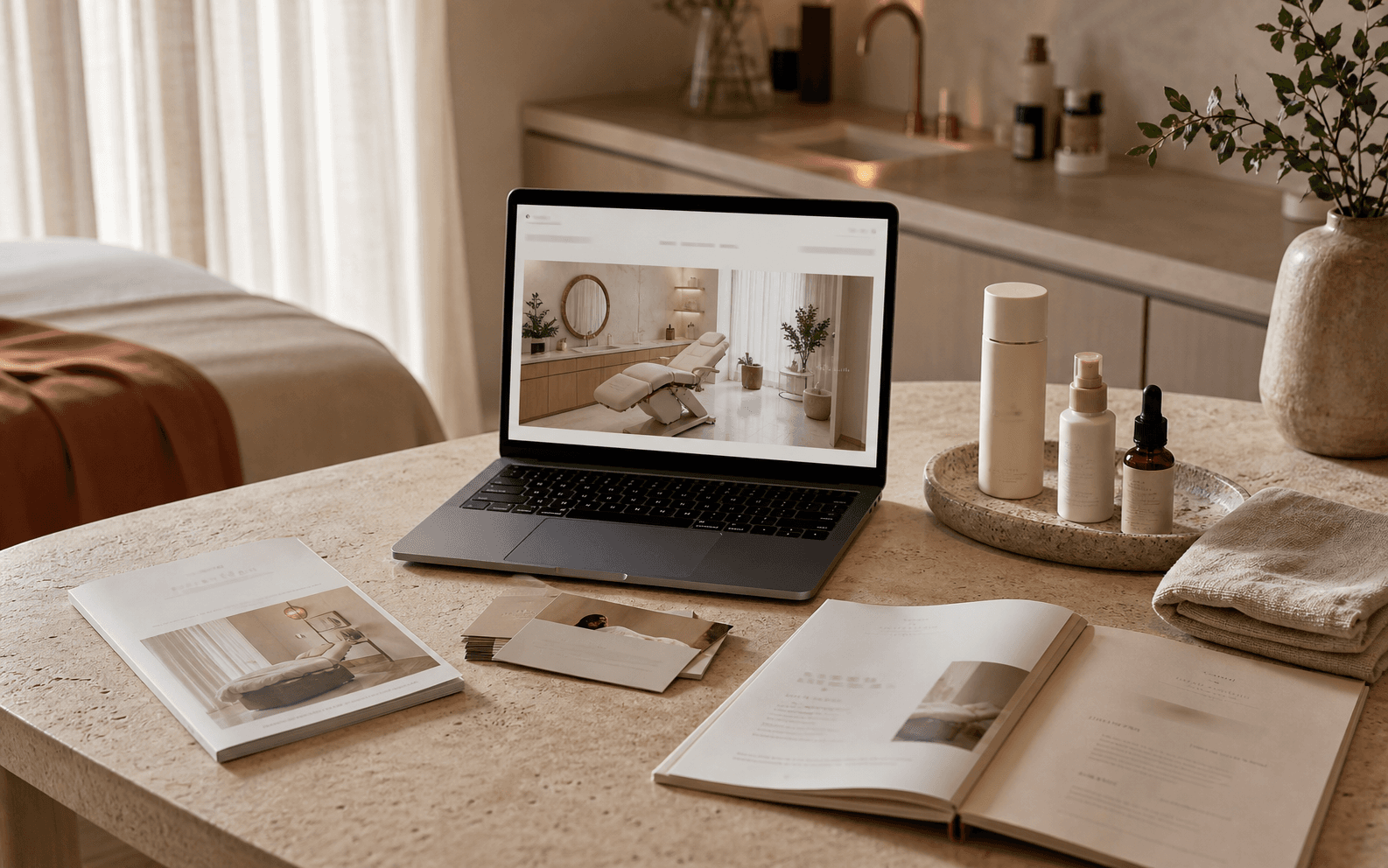
Useful image families include treatment-room details, branded service menus, consultation materials, aftercare cards, product displays, gift cards, appointment reminders, and calm staff-process moments. These do not need to expose private client information. They need to show that the med spa has a system. The same image families can support the website, Google Business Profile, Instagram covers, printed menus, and launch campaigns.
Print collateral can make the website more believable
Print is often treated as separate from web design, but for med spas it can strengthen digital trust. A well-designed aftercare card, consultation folder, service menu, membership card, referral card, or gift card gives the brand a tangible layer. When those materials appear in website photography and social content, the business feels more established.
This matters because customers are not only judging the treatment. They are judging organization. If the website says the experience is premium but the downloadable menu, intake handout, and social promotion all look unrelated, trust weakens. If those pieces use the same brand system, the customer sees a business that can carry care from first click to follow-up.
Prepare content blocks for AI search and staff use
A strong service page should leave behind reusable content blocks. These blocks can describe the treatment, concerns addressed, expected appointment flow, prep notes, aftercare reminders, location-specific service availability, and booking next steps. They help AI systems understand the page, but they also help staff answer inquiries consistently.
For a NY/NJ med spa with multiple services, this becomes an operating advantage. The same approved language can inform website sections, FAQ schema, Google profile updates, Instagram captions, printed cards, email responses, and consultation PDFs. The point is not to repeat the same paragraph everywhere. The point is to keep the core facts aligned while adapting the format to each channel.
- Write one direct answer for what the service is.
- Add eligibility, timing, preparation, and aftercare notes where appropriate.
- Create location-aware copy for neighborhoods, towns, or service areas.
- Store approved short, medium, and long versions for web, print, and social use.
Production-ready files prevent refresh drift
The best service-page strategy will weaken if the files are not organized. A new treatment launch may need a web page hero, square Google image, vertical social cover, printed service insert, email graphic, consultation PDF, and booking-page thumbnail. If each asset is recreated in a rush, the brand will slowly drift.
Production-ready files keep the system usable. Prepare source files, export sizes, image crops, print-ready PDFs, and naming rules before the campaign is urgent. The file system should make it easy to update a treatment page, send a printer the right menu, post a seasonal offer, or create a social carousel without rebuilding the brand every time.
A practical refresh path
Start with the treatments that drive the most inquiries or the most confusion. Audit each page for direct answers, page hierarchy, local context, FAQs, proof visuals, next steps, and consistency with printed or social materials. Then choose one service page as the model and build the system around it before scaling to the rest of the menu.
A realistic first refresh might include one stronger service page, a better image set, a redesigned service menu, an aftercare card template, social cover crops, Google Business Profile visuals, and a simple folder structure for exports. That is enough to make the brand feel more prepared without turning the project into an oversized rebrand. For local med spas, the win is a website and asset system that feels clear to AI search, clear to staff, and reassuring to the person deciding whether to book.
Frequently asked questions
What makes a med spa service page AI-search-ready?
It uses clear headings, direct answers, treatment-specific details, local context, FAQs, structured data where appropriate, and consistent supporting content across the website and related assets.
Does AI search readiness replace brand design?
No. Structure helps the page get understood, but brand identity, visuals, tone, print collateral, and production quality help clients decide whether the med spa feels credible and worth booking.
What visual assets should a med spa prepare for service pages?
Prepare treatment-room details, branded service menus, consultation materials, aftercare cards, product or gift card images, Google profile crops, social covers, and web-ready hero images.
How should a med spa start refreshing its website?
Start with the highest-value or most confusing service page, improve its structure and proof assets, then use that page as the template for the rest of the service menu.
Need a sharper customer-facing system?
Improve consistency across the brand, website, and sales materials.
Visual Square helps NY/NJ businesses clean up the touchpoints customers actually see first, so the brand feels clearer, more credible, and easier to trust.
Talk through the refresh