
Article · Aug 6, 2026
Professional Service Websites Need Agent-Ready Proof Systems
How NY/NJ professional service firms can structure websites, proof, print collateral, and campaign files for human buyers and AI search experiences.
12 min read
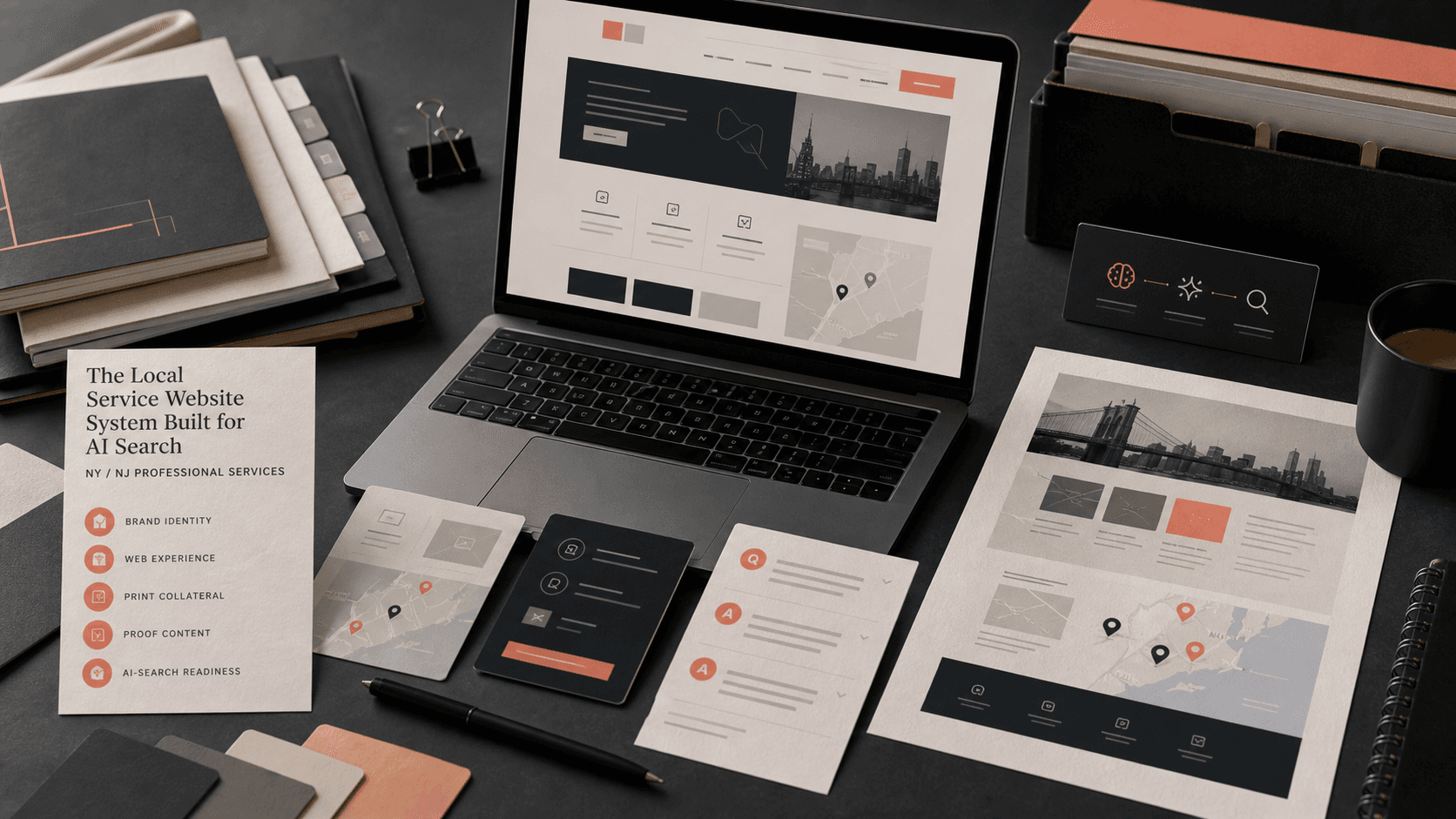
Professional service websites now have to persuade people and be understandable to AI search systems. The strongest sites connect clear service pages, proof, FAQs, print collateral, and production-ready campaign files into one trusted system.
In this article
- 01The website has to work before the call
- 02AI search rewards the same discipline buyers need
- 03Build proof pages, not only service pages
- 04Turn the service page into a decision path
- 05The brand identity should make expertise easier to read
- 06Print and PDFs are part of the answer system
- 07Production-ready files prevent the brand from drifting
- 08A practical NY/NJ refresh plan
The website has to work before the call
Professional services are often sold through referrals, introductions, and conversations, but the website still shapes the buyer's confidence before that conversation starts. A law office, accounting firm, consultant, healthcare-adjacent advisor, architecture studio, or local B2B service provider may get warm leads, yet those leads still check the website, LinkedIn presence, Google profile, PDFs, proposal materials, and review signals before deciding whether the firm feels credible enough to contact.
In New York and New Jersey, that pre-call evaluation is especially compressed. Prospects compare several firms quickly, skim service pages on mobile, ask AI search tools for options or explanations, and look for proof that the firm understands their situation. A polished homepage is useful, but it is no longer enough. The site has to answer what the firm does, who it helps, where it serves, how the process works, what proof exists, and what a realistic next step looks like.
AI search rewards the same discipline buyers need
Recent AI search guidance points back to fundamentals: useful content, accessible pages, clear structure, accurate business information, and proof that the source deserves trust. The practical lesson for local professional services is not to chase every new acronym. It is to make the website easier for people and systems to understand.
That means the site should avoid vague statements like full-service solutions, trusted partner, or tailored strategy without explaining the service in concrete terms. A good page states the offer, names the buyer, explains common problems, shows the process, answers frequent objections, and connects the visitor to a next action. Those are conversion improvements and AI-search improvements at the same time.
- Use specific service names instead of broad capability labels.
- Put a short answer or summary near the top of important pages.
- Add process, proof, FAQ, and local context where buyers naturally need them.
- Keep Google Business Profile, website, PDFs, and social profiles aligned.
Build proof pages, not only service pages
Many professional service sites have a homepage, about page, contact page, and a list of services. That structure can be too thin for a buyer who is trying to decide whether the firm has handled a similar situation before. Service pages explain what you offer. Proof pages explain why the buyer should believe you.
A proof page does not have to reveal confidential client details. It can show anonymized project patterns, before-and-after process improvements, deliverable examples, document systems, engagement types, frequently solved problems, or a clear point of view on how the firm works. For a local firm, proof can also include NY/NJ market familiarity, neighborhood or industry context, bilingual communication when relevant, and the physical materials used in meetings or follow-up.
Turn the service page into a decision path
The strongest service pages behave like guided decision paths. They start with a clear promise, then show who the service is for, what problems it solves, what the engagement includes, what the process looks like, what the buyer should prepare, and how to start. The design should make that path easy to scan instead of hiding key answers inside long paragraphs.
This does not mean every page needs aggressive sales copy. Professional service buyers often need calm clarity more than pressure. They want to know whether the firm is organized, whether the scope is understandable, whether they will be listened to, and whether the next step is low-friction. A well-designed page uses hierarchy, spacing, summaries, bullets, and FAQs to reduce uncertainty.
- Open with the service, buyer, and outcome in plain language.
- Show process steps so the visitor understands what happens after inquiry.
- Place proof near moments where a prospect may hesitate.
- Use specific calls to action such as request a consultation, send project details, or schedule an audit.
The brand identity should make expertise easier to read
Professional services often lean on restrained design, but restrained should not mean anonymous. The identity system has to make expertise feel clear, current, and specific. Typography, color, image direction, icon use, and document layout should support the firm's positioning instead of copying a generic corporate template.
A consulting firm may need structured diagrams and sharp presentation layouts. An accounting or advisory practice may need calm document systems and readable comparison tables. A legal or compliance-focused business may need authority, restraint, and extremely clear next steps. The visual language should make the buyer feel that the firm has a method, not just a logo.
Print and PDFs are part of the answer system
Professional service buyers rarely stay in one channel. They may read a service page, download a one-page overview, forward a PDF to a partner, review a proposal deck, save a business card, or revisit a LinkedIn document before responding. If those materials use different language and design systems, the firm feels less organized.
A practical refresh should connect the website to printed and digital collateral. The same service summary can become a one-pager. The same process section can become a deck slide. The same FAQ can become a follow-up email or LinkedIn document. The same proof modules can support a proposal, sales sheet, Google profile update, and social carousel. This creates repetition without making every asset feel copied.
Production-ready files prevent the brand from drifting
A website redesign can look excellent at launch and still fall apart during operations if the supporting files are not prepared. New service pages need image crops. LinkedIn documents need readable slide layouts. Google profile images need safe thumbnails. Sales PDFs need export settings. Print pieces need size, bleed, paper, and vendor-ready files. Without that structure, every campaign becomes a new design emergency.
Production-ready file systems are not administrative clutter. They are how a professional service brand stays consistent when the firm is busy. Approved logos, page section templates, PDF masters, social cover files, proposal graphics, and naming conventions make updates faster while preserving the trust signals that the website established.
A practical NY/NJ refresh plan
Start by auditing the places a prospect sees before contacting the firm: homepage, service pages, Google Business Profile, LinkedIn page, one-pagers, proposal deck, email signature, review links, printed cards, and any downloadable PDFs. Mark which pieces clearly explain the offer, which pieces prove credibility, which pieces look outdated, and which pieces use inconsistent language.
Then fix the highest-leverage path first. For many NY/NJ professional service firms, that means one strong service page, one proof or case-pattern page, one updated one-pager, one LinkedIn document, a refreshed Google profile image set, and production-ready files for future campaigns. The goal is not to make the firm look like a larger corporation. The goal is to make the real expertise easier to understand, trust, quote, share, and act on.
Frequently asked questions
What does agent-ready mean for a professional service website?
It means the website is structured so people, search engines, and AI search experiences can understand the service, location, process, proof, FAQ answers, and next steps without guessing.
Does AI search replace SEO for local firms?
No. The practical work is still strong SEO: useful content, clear structure, accessible pages, accurate business information, and credible proof. AI search makes those fundamentals more important.
What should a professional service firm update first?
Start with the homepage, highest-value service page, proof or case-pattern content, Google Business Profile visuals, and the one-page PDF or deck prospects most often receive.
How do print collateral and PDFs support AI-search-ready content?
They keep the same service explanations, proof, process steps, and next actions consistent across channels, which helps buyers trust the firm after they leave the website.
Need a sharper customer-facing system?
Improve consistency across the brand, website, and sales materials.
Visual Square helps NY/NJ businesses clean up the touchpoints customers actually see first, so the brand feels clearer, more credible, and easier to trust.
Talk through the refresh